Faster Rust CI Jobs
Compiling Rust is slow out of the box.
This becomes a problem in CI.
One small change can kick off a 15+ minute CI job.
This is not ideal from a cost or developer experience perspective.
In this post I take a real workflow from roughly 26 minutes down to under 5 minutes
and walk through each optimization.
Why Rust Behaves This Way
There are three areas that cause Rust to compile slowly:
- Dependency Compilation
- Project Compilation
- Linking
Build times are particularly painful in Rust because it relies heavily on monomorphization. That sounds like a big scary word, but it isn’t. It means every time there is some generic type used in your Rust code, the compiler generates implementations for each concrete type.
…ok, maybe that is kind of advanced. If you don’t understand what that means, don’t worry about it; know that this is a lot of work, and you want to avoid it when you can.
Cargo’s default local caching behavior lets you avoid it when building locally.
In contrast, when a GitHub Actions runner starts, it is a clean slate. It downloads everything and does all three steps every time.
An Unoptimized CI Job
An unoptimized GitHub Actions workflow might look like this. The comments label six baseline behaviors. Each one gets addressed in the next section.
name: Unoptimized Rust CI
permissions: contents: read
on: push: branches: - main pull_request: workflow_dispatch:
jobs: validate: name: Validate (lint, test) runs-on: ubuntu-latest
# Baseline #1 (Linker): no RUSTFLAGS override, so every link # step uses the default GNU ld. # Baseline #2 (Compiler Cache): no sccache, so every compilation # unit is rebuilt from scratch on every run. # Baseline #3 (Dependency Cache): no cache action, so all # dependencies are recompiled on every run. steps: - name: Checkout uses: actions/checkout@v6
- name: Install Rust uses: dtolnay/rust-toolchain@stable
- name: cargo fmt run: cargo fmt -- --check
- name: cargo clippy run: cargo clippy --locked --all-targets --all-features -- -D warnings
# Baseline #4 (Test Runner): plain `cargo test`, which runs test # binaries with less parallelism than nextest. - name: Run tests run: cargo test --locked --all-features
build: name: Build (${{ matrix.target }}) runs-on: ubuntu-latest needs: [ validate ] strategy: fail-fast: false matrix: target: - x86_64-unknown-linux-musl - aarch64-unknown-linux-musl
steps: - name: Checkout uses: actions/checkout@v6
- name: Install Rust uses: dtolnay/rust-toolchain@stable
# Baseline #5 (Cross Compilation): `cargo install` compiles # the cross tool from source on every run before any project # code builds. - name: Install cross run: cargo install cross
# Baseline #6 (Build Environment): cross runs the build inside # a Docker container that must be pulled first, once per matrix # target. - name: Build with cross run: cross build --release --locked --target ${{ matrix.target }}
- name: Upload binary uses: actions/upload-artifact@v7 with: name: rust_build_demo-${{ matrix.target }} path: target/${{ matrix.target }}/release/rust_build_demoStep-by-Step Optimization
There are six areas where the job can be optimized.
| Category | Unoptimized baseline | Optimized |
|---|---|---|
| #1 Linker | default GNU ld | mold linker via RUSTFLAGS |
| #2 Compiler Cache | no compiler cache, full rebuild every run | sccache with GHA backend |
| #3 Dependency Cache | no dependency cache, dependencies recompile every run | Swatinem/rust-cache |
| #4 Test Runner | plain cargo test | nextest via prebuilt binary |
| #5 Cross Compilation | cargo install cross compiled from source every run | cargo-zigbuild via prebuilt binary |
| #6 Build Environment | cross builds inside Docker containers it must pull first | Zig cross-linking on the host |
#1 Linker
An alternative linker is a huge gain. Linking is the final, serial step of every build, and mold is dramatically faster at it than the default GNU ld. mold only supports Linux, so if you are developing locally on Mac or Windows you are stuck with the default linker. However, GitHub Actions runners are Linux, which allows mold to be used.
Enable mold with an environment variable and an apt package:
env: RUSTFLAGS: "-C link-arg=-fuse-ld=mold"
steps: - name: Install mold run: sudo apt-get update -y && sudo apt-get install -y mold#2 Compiler Cache
Without a compiler cache, every run rebuilds every compilation unit from scratch.
A solution to this is mozilla-actions/sccache-action,
which wraps sccache.
Setting RUSTC_WRAPPER routes every rustc invocation through sccache, and SCCACHE_GHA_ENABLED stores the
results in the GitHub Actions cache.
Compilation units that have not changed are fetched instead of rebuilt.
This is the barebones action setup:
env: SCCACHE_GHA_ENABLED: "true" RUSTC_WRAPPER: sccache
steps: - name: Configure sccache uses: mozilla-actions/sccache-action@v0.0.10#3 Dependency Cache
Without a dependency cache, dependencies recompile every run (which, as we’ve established, is slow).
A solution to this is Swatinem/rust-cache.
It has sensible defaults.
It fingerprints Cargo.lock and saves and restores ~/.cargo and the compiled dependencies in target/
between runs, so unchanged dependencies are never recompiled.
It is important that you use the –locked flag for tools (e.g., clippy, nextest) or those tools will automatically
regenerate the lockfile, which breaks caching.
rust-cache also composes well with sccache. It restores whole build directories keyed on your lockfile, while sccache catches individual compilation units when that key misses.
- name: Cache Rust dependencies uses: Swatinem/rust-cache@v2 with: key: validation#4 Test Runner
Plain cargo test runs each test binary one at a time.
cargo-nextest runs every test in its own process and schedules them in parallel across
binaries, which adds up as a test suite grows.
Just as important is how it gets installed.
taiki-e/install-action downloads a prebuilt binary in about a
second instead of compiling a tool from source with cargo install.
- name: Install cargo-nextest uses: taiki-e/install-action@nextest
- name: Run tests run: cargo nextest run --locked --all-features#5 Cross Compilation
The unoptimized workflow runs cargo install cross, which compiles the cross tool from source on every run
before a single line of project code builds.
The replacement is cargo-zigbuild, installed as a prebuilt
binary through the same install action as nextest.
- name: Install cargo-zigbuild uses: taiki-e/install-action@cargo-zigbuild#6 Build Environment
cross runs each build inside a Docker container that the runner must pull first, once per matrix target. cargo-zigbuild takes a different approach. It drives an ordinary host-side cargo build and uses Zig as the cross-compiling C toolchain and linker. Both musl targets build on a plain x86_64 runner with no Docker images to pull, no QEMU, and no dedicated ARM hardware.
- name: Install Zig uses: mlugg/setup-zig@v2 with: version: "0.15.1"
- name: Build with zigbuild run: cargo zigbuild --release --locked --target ${{ matrix.target }}Full Optimized Example
Putting all six optimizations together:
name: Optimized Rust CI
permissions: contents: read
on: push: branches: - main pull_request: workflow_dispatch:
jobs: validate: name: Validate (lint, test) runs-on: ubuntu-latest env: # Optimization #1 (Linker): tell rustc to link with mold # instead of the default GNU ld. Linking is the final, serial # step of every build, and mold is dramatically faster at it. RUSTFLAGS: "-C link-arg=-fuse-ld=mold" # Optimization #2 (Compiler Cache): wrap every rustc invocation # with sccache and store the results in the GitHub Actions # cache, so compilation units that have not changed are fetched # instead of rebuilt. SCCACHE_GHA_ENABLED: "true" RUSTC_WRAPPER: sccache
steps: - name: Checkout uses: actions/checkout@v6
- name: Install Rust uses: dtolnay/rust-toolchain@stable
# Optimization #1 (Linker): install the mold binary that the # RUSTFLAGS entry above points at. - name: Install mold run: sudo apt-get update -y && sudo apt-get install -y mold
# Optimization #2 (Compiler Cache): install sccache and wire it # up to the GitHub Actions cache backend. - name: Configure sccache uses: mozilla-actions/sccache-action@v0.0.10
# Optimization #3 (Dependency Cache): restore ~/.cargo and the # compiled dependencies in target/ between runs, so unchanged # dependencies are never recompiled. - name: Cache Rust dependencies uses: Swatinem/rust-cache@v2 with: key: validation
- name: cargo fmt run: cargo fmt -- --check
- name: cargo clippy run: cargo clippy --locked --all-targets --all-features -- -D warnings
# Optimization #4 (Test Runner): download a prebuilt # cargo-nextest binary instead of compiling a tool from source # with `cargo install`. - name: Install cargo-nextest uses: taiki-e/install-action@nextest
# Optimization #4 (Test Runner): nextest runs each test in its # own process and schedules them in parallel more effectively # than plain `cargo test`. - name: Run tests run: cargo nextest run --locked --all-features
build: name: Build (${{ matrix.target }}) runs-on: ubuntu-latest needs: [ validate ] env: # Optimization #2 (Compiler Cache): sccache again, shared # across both matrix targets through the GitHub Actions cache. SCCACHE_GHA_ENABLED: "true" RUSTC_WRAPPER: sccache strategy: fail-fast: false matrix: target: - x86_64-unknown-linux-musl - aarch64-unknown-linux-musl
steps: - name: Checkout uses: actions/checkout@v6
- name: Install Rust uses: dtolnay/rust-toolchain@stable with: targets: ${{ matrix.target }}
# Optimization #6 (Build Environment): Zig provides the # cross-compiling C toolchain and linker directly on the host # runner. Both musl targets build on a plain x86_64 runner with # no Docker images to pull, no QEMU, and no dedicated ARM # hardware. - name: Install Zig uses: mlugg/setup-zig@v2 with: version: "0.15.1"
# Optimization #2 (Compiler Cache): see the validate job. - name: Configure sccache uses: mozilla-actions/sccache-action@v0.0.10
# Optimization #3 (Dependency Cache): keyed per target so each # matrix leg restores its own compiled dependencies. - name: Cache Rust dependencies uses: Swatinem/rust-cache@v2 with: key: ${{ matrix.target }}
# Optimization #5 (Cross Compilation): download a prebuilt # cargo-zigbuild binary. The unoptimized workflow compiles its # cross tool from source with `cargo install` on every run. - name: Install cargo-zigbuild uses: taiki-e/install-action@cargo-zigbuild
# Optimizations #5 and #6: cargo-zigbuild drives an ordinary # host-side cargo build and uses Zig as the cross-linker, # replacing the Docker-based `cross build` from the unoptimized # workflow. - name: Build with zigbuild run: cargo zigbuild --release --locked --target ${{ matrix.target }}
- name: Upload binary uses: actions/upload-artifact@v7 with: name: rust_build_demo-${{ matrix.target }} path: target/${{ matrix.target }}/release/rust_build_demoThe Results
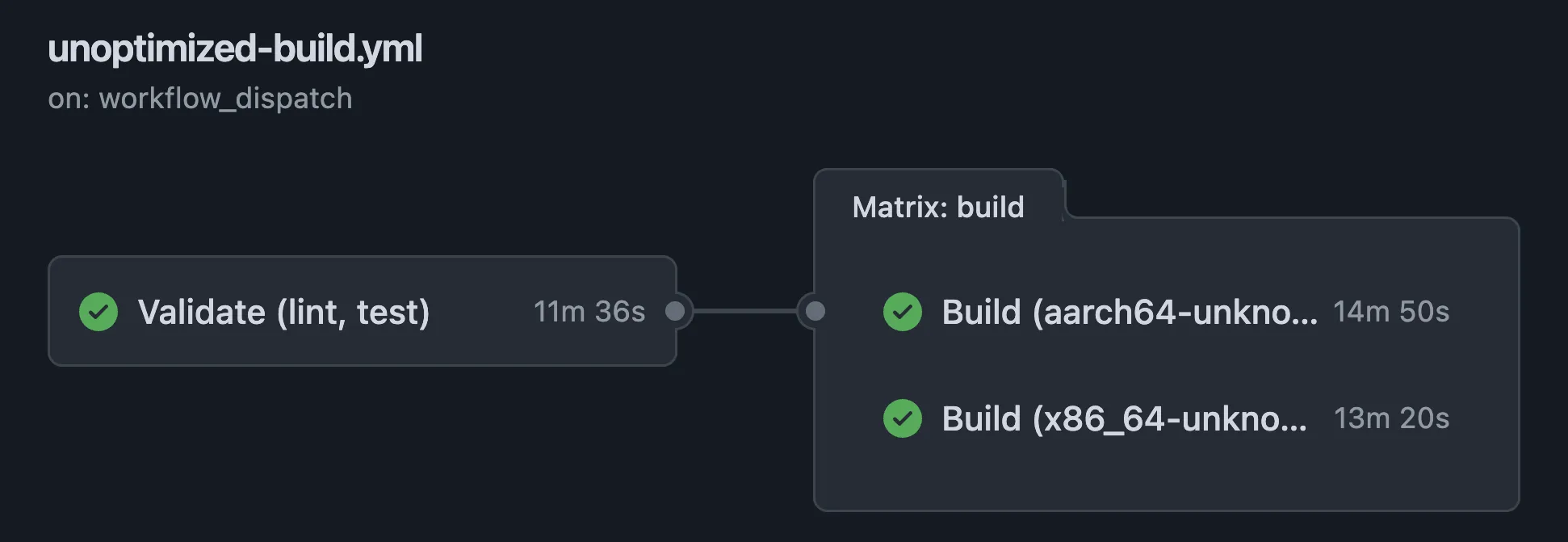
Both workflows run the same lint, test, and cross-compile work on the same project. Here is the unoptimized run:
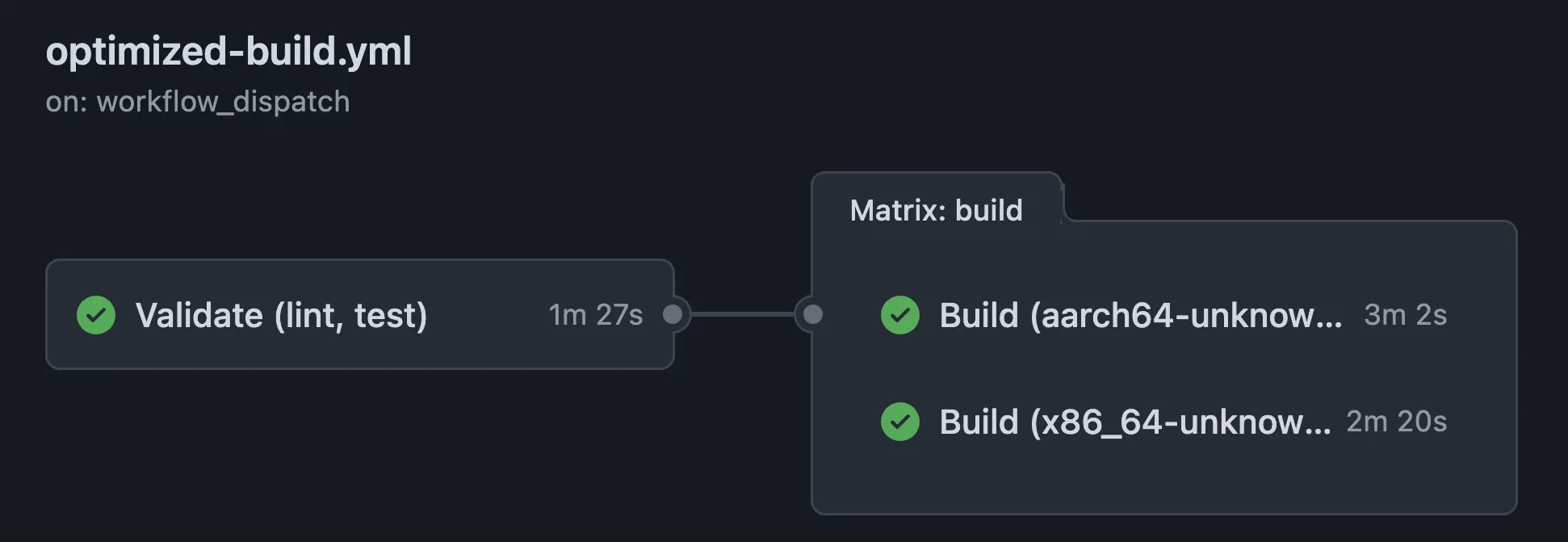
And the optimized run:
| Job | Unoptimized | Optimized |
|---|---|---|
| Validate (lint, test) | 11m 36s | 1m 27s |
| Build (x86_64 musl) | 13m 20s | 2m 20s |
| Build (aarch64 musl) | 14m 50s | 3m 2s |
Because the build matrix runs in parallel after validation, end-to-end wall clock time drops from roughly 26 minutes to about 4 and a half. The step-level numbers in the validate job are even more dramatic.
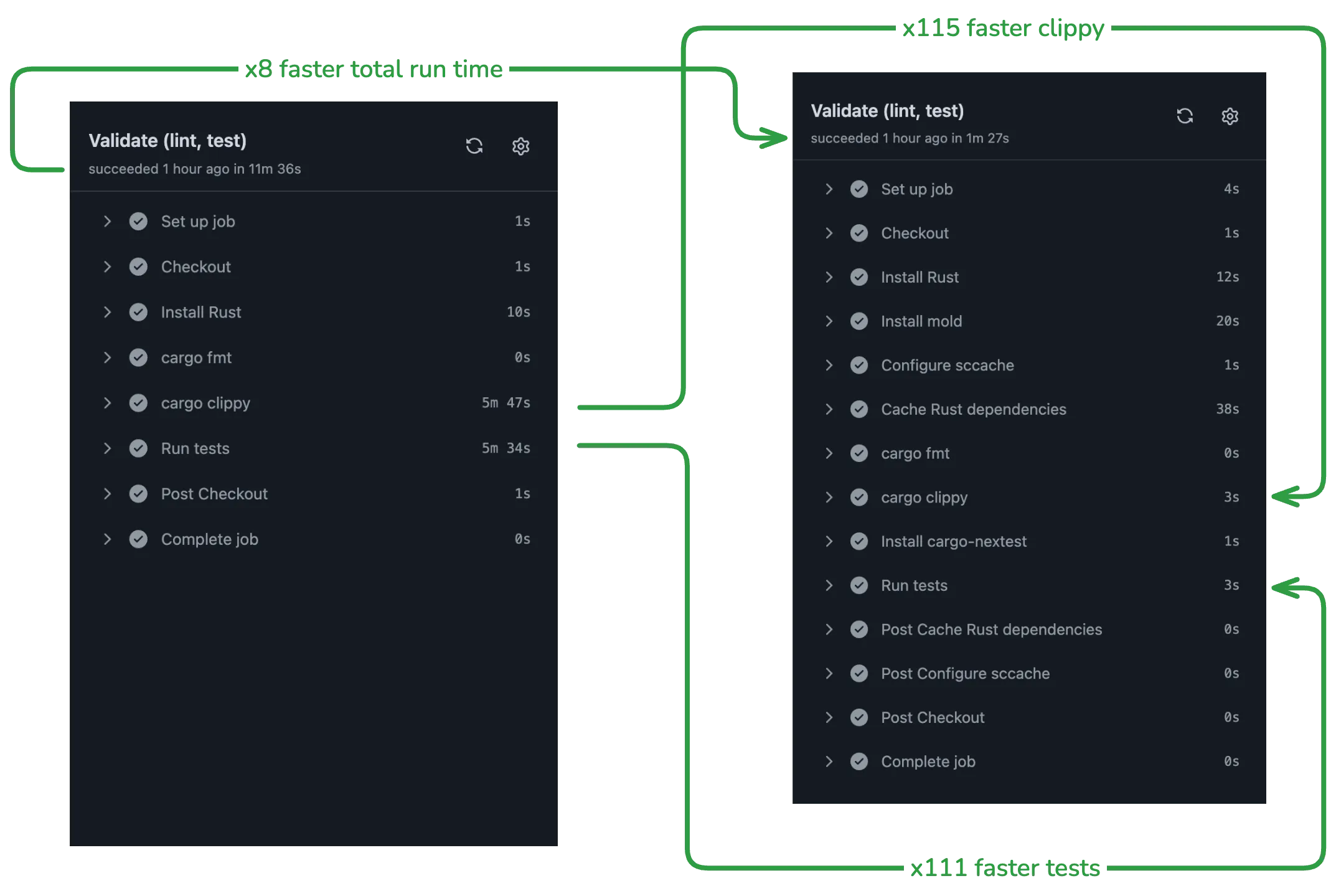
To be fair about attribution, the clippy and test steps owe most of that speedup to the caches, since the compilation they used to do is already done. mold and nextest keep the remaining work fast, and they matter more as a project and its test suite grow.
The Caveats
Caching has limits, and it is worth knowing them before you rely on these numbers.
- The optimized timings above are warm-cache runs.
The first run after a change to
Cargo.lockbreaks the dependency cache and must re-prime it, so that run will look a lot more like the unoptimized one. - GitHub Actions has a 10GB cache limit per repository. A massive dependency tree, or many matrix targets each with their own cache key, can evict entries and quietly hand you cold builds.
moldonly helps on Linux runners. If your CI runs on macOS or Windows, the linker row of the table does not apply.crossis not a bad tool. It exists to provide reproducible cross-compilation environments, and if you need its container-level control, the Docker cost may be worth it. For plain musl targets, Zig does the same job faster.
Wrap-up
None of these changes touched the application code.
Six workflow-level swaps took the same pipeline from roughly 26 minutes to under 5.
If you only take one thing from this post, add Swatinem/rust-cache and sccache to your workflow. Those two lines of YAML are where most of the minutes go.
The workflows were run in ethanhann/rust_build_demo.